Wednesday, 15 June 2011

I love herbs!

The completed garden
I love herbs! I've always had a yen to try out my own herbal tonics and creams, etc and, of course, I love using them in cooking - both fresh and dry - and for years have had a pot of two on the windowsill. Unfortunately, these never seem to last too long (I'm not very good with indoor plants!) and so ever since we moved here I've been itching to develop my very own herb garden.

Well, having finally cleared the large brick-built raised beds near the house, I decided that the largest area would make a fantastic space for a herb garden. We already have an enormous lavender bush which we inherited with the house and the pergola area has been underplanted with some herbs in pots for a year now, but I wanted an area dedicated completely to herbs too. I did quite a lot of research into what herbs to grow - I wanted to have a good range of those I use regularly in cooking (basil, mint, rosemary, oregano), along with those that I tend to leave out because we don't need them very often and therefore never get round to buying (parsley, coriander and dill), some I don't use enough (chives, thyme and sage) and some new ones just to experiment with (summer savoury and tarragon). I also looked at various layouts for traditional gardens, but due to the nature of the space, have ended up with a version all my own.

preparing the space
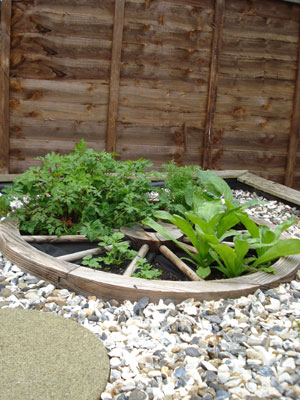
1. Planning the space and preparing the ground. I'm not much of a one for detailed, to-scale plans (even though I have the graph paper, I just get too excited and impatient!) so I sketched out my idea in a notebook. I wanted to take the idea of a herb wheel and apply it to the rectangular space, with the main planting in the wheel bordered by some of the bushier herb varieties. I wanted an actual cartwheel to plant into (it's amazing what you can find on ebay), but when it came to it, couldn't find any big enough for the space, so had to adapt my design based on using two smaller wheels instead - one for herbs with a mainly culinary use and the other for medicinal/home/craft use. The main preparation once the bed was cleared of the old shrubs, involved digging it over, covering it with weed-proof membrane and then placing the wheels.

2. The new layout has three planting areas: the wheels, the curved corner areas and some terracotta pots. Once I'd worked out what herbs I wanted, I ordered some as plants and some as seeds (to keep costs down). We bought two terracotta pots from the garden centre and we inherited a third which came with the garden.

3. Planting up the wheels. Each wheel has twelve spaces between the spokes, so I decided to plant six herbs per wheel, with each herb allotted two spaces. The only exception to this are my chives, where I have one space for common chives and one space for garlic chives. The wheels are planted up as:

Wheel 1: Culinary

  • Chives (common and garlic)
  • Summer savoury
  • French tarragon
  • Coriander
  • Apple mint
  • Oregano


Wheel 2: Medicinal/Household/Craft
  • Chamomile
  • Borage
  • Calendula
  • Feverfew
  • Hyssop
  • Herb robert


One of my corner borders is a selection of thymes (common, lemon and creeping) and the other is made up from taller herbs (dill, rosemary (two varieties), sage and flat-leaved parsley). Finally, two of the three pots hold goji berry bushes and the third is a sweet bay. Elsewhere in the garden we've lemon balm, lavender (as mentioned), black peppermint and more rosemary, hyssop, tarragon and thyme.

tall herbs in the left corner
thymes in the right corner
4. Finishing touches. The finishing touches included covering the weed-proof membrane with gravel and placing the terracotta pots.

It's so exciting to be able to nip out and pick my own fresh herbs to add to dishes, even at this stage when some of my plants aren't quite ready. We've had mint in a potato salad and with strawberries; coriander in a number of curry dishes, tarragon in a chicken dish and rosemary. I'm in the process of developing a recipe for mint and lemon biscuits (watch this space) and I'm sure the other herbs will come into their own over the next few weeks and months too.

Monday, 6 June 2011

Feed me!

I've been particularly excited recently as our high chair and feeding set have arrived for Izzy. She's four-and-a-half months old already and we'll soon be using them - doesn't time fly?!

Last week we attended a weaning class, run by our area Health Visitors in a local surgery. Babies at the class ranged in age from four to five-and-a-half months. The practice nurse started off the discussion by asking if anyone knew the government-recommended age for weaning babies. 'Six months' piped up someone from the other side of the room. 'Yes, it's really changed from my day, when people started weaning as young as three months. So, how many of you are weaning?' It turned out about two thirds of the people at the class have already given their baby solid foods, mostly baby rice or pureed fruit - even though they were fully aware of the government advice.

Now, I'm not one for believing everything the government tells me and I also firmly believe that as a parent I should be able to choose what feels right for myself and my child, without being made to feel guilty by the state, the health service or friends and family. Yet, I'm afraid I've got to ask: 'What is the rush?' Although many of these babies had good head and neck control none of them could sit unsupported. None of the mothers had been advised to wean for medical reasons. They'd just felt it was 'time', either based on conversations with friends and family, or the fact that their baby had started to show an interest in what they were eating, or had started waking in the night. It can be argued that none of these are truly 'signs' that a baby is ready to eat. He may just be showing an interest in you eating, because he learns all his social and physical cues from you. He may be waking in the night because something else is bothering him, or for no real reason at all. And just because someone else's baby is eating solids, or 'you were eating two meals a day when you were his age' doesn't mean that you should rush to catch up! Apparently the best sign that your baby is ready for solids is if his weight gain tails off for at least a couple of weeks (just one week could be the result of a cold, a growth spurt or some other factor).

After this somewhat leading opening, the class was then shown a DVD of the baby-led weaning method popularised by former midwife and health visitor, Gill Rapley. I'd already heard of this approach and as a result have actually read her book, but the DVD was a good summary of what I'd consider to be the main points:
  • don't offer any food until at least six months, when a baby's gross motor skills and digestion are better developed;
  • to start, offer baby food cut into easy-to-hold shapes;
  • initially they won't eat it at all - it's just a new game to them - but one that is developing their sense of taste, their chewing action and their ability to move food around their mouths;
  • be prepared for a mess and you won't be taken by surprise;
  • always eat with your baby, let them eat the 'meal' at their own pace and avoid trying to help them by picking food up and giving it to them or putting it in their mouths;
  • when they're starting to 'eat' more purposefully, give them a baby-sized portion of your meals (assuming you eat a healthy, balanced diet, the only thing you might need to change is the amount of salt you use in cooking).
Admittedly, both the DVD and the book I've read aim to 'sell' you the concept of baby-led weaning, and perhaps overstate the negatives of other weaning methods. (I'm sure most parents don't really shovel the pureed food into their babies' mouths but let them eat at their own pace). However, the principles seem to be fairly sensible, and the advice about starting out is definitely something we're planning to follow. Again, in brief:
  • once your baby is able to sit in his highchair, allow him to sit with you for family meals (or alternatively, sit him on your knee). At this stage, you might want to give him a spoon or plate to play with too;
  • if he seems interested, start offering him food from your plate;
  • when this interest becomes regular, give him his own food, cut into appropriate shapes with a 'handle' for him to grasp.
You can find out more about the full process via Gill Rapley's website.

The class were then given some information relating to more 'traditional' methods as well as a brief discussion of the DVD we'd just watched. It was really quite surprising to hear people ask questions about 'how long' babies should feed for when weaning, 'how many' meals to give them and 'how much' should they eat. The vast majority of these mothers have breastfed and are still breastfeeding, so surely they should be used to the idea that their baby will eat when and if he is hungry, and will take as much as he needs to satisfy himself? Trying to control how much your baby/toddler eats is surely a straight road to eating problems later on?

Personally, although I'm excited about her reaching this next stage, I'm prepared to wait until Izzy's ready. This is helped, somewhat, by the fact that I'd love her to mainly eat things that we've grown ourselves, and for that we need to wait until August/September for the bulk of our crops anyway. With little hands, mouths and stomachs in mind I'm hoping to get good crops from our runner beans, baby carrots, apples, raspberries, plums, brocolli, sweetcorn and globe courgettes in particular, for the finger food phase, before she moves on to joining in fully with our meals.

Friday, 20 May 2011

Nationwide strawberry panic!

Summer = strawberries
 'Strawberry boom may be out of juice by summer', says The Independent, with typical understatement.

That's right, tennis fans, that incredibly hot April we had may have done even more damage than we thought. In addition to out-of-season sunburn and the chore of having to unpack summer wardrobes early, the temperature has apparently also impacted on the strawberry growing season. Strawberry farms across the south are reporting that the plants are cropping earlier than in the last decade and may peak before Wimbledon. Firstly, how quaint does a 'strawberry farm' sound? They must surely be the preserve (pun intended) of little squirrels in gingham shirts and other such Tales from the River Bank characters. Secondly, I note the article is full of 'may' and 'could' and 'perhaps' - I'm pretty sure that you get strawberry varieties that crop at different times through the summer and surely some farms will have produce for Wimbledon? Frankly, I'm amazed that the overpriced strawberries at Wimbledon are actually British-grown anyway - surely a larger profit margin is to be had from shipping in under-ripe Elsanta's from Holland and Spain and giving them the briefest of introductions to some mass-produced cream? Or is that too cynical?

What I find the more interesting part of the article is the news that pick-your-own farms are reporting an increase in the number of people stuffing themselves in the fields and effectively only paying for half what they've picked - making it more like pick-your-own-and-eat-it-so-you-only-pay-for-what-you-pack. I can't believe that this hasn't always been a problem for PYO farms so I'm not sure why it's being reported on now. What I can't understand is why, if people want to pick their own strawberries, they don't employ a GYO (grow your own, dummies!) attitude.

Established fruit from last year
We've found strawberries to be one of the easiest crops to grow. Stick 'em in a pot with some compost, sit them in a sunny spot and water regularly. You'll be rewarded not just with lovely fresh fruit but if you pot on the runners, additional plants for next year for free. Strawberries have a three-year life cycle, so it's a good idea to try and propagate runners to replace about one-third of your crop each year so that you maintain your stock (propagate more if you want to increase it).We bought about 25 plants last year of a single variety and had about 10 plants from the runners to pot up for this year - although we could have had more. These were spread between terracotta pots under our pergola and hanging baskets - I can't say that there was much difference between them for cropping, although obviously it was easier to propagate the runners from the plants on the ground!

This pot holds some of the plants we propagated from runners last year - they're looking very promising!
This year we've bought another 20 plants, of two new varieties, to try and get enough fruit to satisfy our preserving bug, as well as giving us plenty of fruit fresh from the plants. (Watch this space over the summer for progress on strawberry preserving - I want to try strawberry jelly and possibly a cordial, and I'm looking forward to experimenting with some of our new herbs too for fruit-and-herb combinations). Our three varieties all have a different cropping period, which should, in theory, extend the cropping season so that we have fruit from May/June right through until September. I'm not sure if it's that crazy April weather again, but all our plants seem to be at a fairly similar stage and I'd hazard a guess that we'll have our first fruits later this month from each of the varieties. The new plants are in one of the brick-built raised beds with our roses, and will need some straw spreading under them soon to prevent the fruit from resting on the soil and rotting. Again, these should be relatively easy to propagate runners from, so we can maintain our crop or increase it as required for next year. Then the only problem will be finding homes for the new plants!

Strawberry bed
NB. I never pay much attention to planting densities, plus I wanted the strawberries to act like a ground cover plant underneath the roses in this bed, so I packed them in.