My first 'real' day in the garden of the year, yesterday. I love spring gardening, the greenhouse is a cosy place to work, rather than being roasting hot. Working on the beds is relatively straightforward as there isn't too much growing. And there aren't many weeds yet - a sure sign that Spring is only just beginning to take hold!
Still, as long as they've survived the shock of being moved to the cold frame last night (we've a light frost this morning), we should get a nice crop of early broad beans this year.
There's plenty of seeds and seedlings on their way inside the greenhouse. I also got around to fitting the capillary matting I bought about 6 weeks ago, to see if this helps with the endless watering required at this time of year - I'll keep you posted!
And I took advantage of the sunshine to prepare all the growing beds for the season ahead, and to finally plant the potatoes which have been chitting in the kitchen since late February.
Fingers crossed for a better growing season in 2013 than we had last year!
Wednesday, 3 April 2013
Monday, 25 March 2013
More things I've made and some toddler-sized sewing first steps
The month of March has mainly been about making. Specifically, I've been sticking to my 2013 goal for generally improving and expanding my needlecrafts and have completed three satisfying projects.
I finished my train project hat just at the point when I thought, 'rats, I won't get much wear out of this at this time of year'. I've since worn it every day to ward off the bitter chill of an English springtime!
Sis-in-law's third baby finally arrived so I got to improve my crochet skills with a pair of bootees, courtesy of a pattern in Simply Crochet mag. They weren't perfect, but hey, the baby won't notice and they should help keep his feet warm at least!
And finally, I completed my first real project using my new sewing machine (I say 'new' - I've had it since November...) I'm not sure why, but I was completely daunted about getting to grips with my sewing machine. I don't remember much about using one from school, other than it seemed to take most of the lesson to get the things threaded, and the only project I really remember completing was to design and create embellishments for a hat - not terribly useful!
So I decided for my first real sewing project in years that, rather than starting with something simple and gradually building up my skills, I'd dive right in and make a dress. At least it was for my toddler, so the cutting out and actual sewing was on a fairly small scale, but I did still need to learn how to:
- cut out from a pattern
- hem
- topstitch
- sew on a curve
- and create buttonholes (really incredibly simple with the buttonhole foot, which is much easier to use than it looks)
The fabrics are an organic needlecord in yellow, and an organic cotton by Cloud9 (Algeria Hearts in Pink), both from Ray Stitch.
And because I never have been able to follow a set of instructions all the way through without adding a couple of extra bits, or tweaks, I decided that instead of the applique design for the skirt I'd add a couple of pockets, which I then designed and made up from scratch.
Here is the finished article:
And here it is being modelled by Isobel!
Lessons learnt?
I finished my train project hat just at the point when I thought, 'rats, I won't get much wear out of this at this time of year'. I've since worn it every day to ward off the bitter chill of an English springtime!
Sis-in-law's third baby finally arrived so I got to improve my crochet skills with a pair of bootees, courtesy of a pattern in Simply Crochet mag. They weren't perfect, but hey, the baby won't notice and they should help keep his feet warm at least!
And finally, I completed my first real project using my new sewing machine (I say 'new' - I've had it since November...) I'm not sure why, but I was completely daunted about getting to grips with my sewing machine. I don't remember much about using one from school, other than it seemed to take most of the lesson to get the things threaded, and the only project I really remember completing was to design and create embellishments for a hat - not terribly useful!
So I decided for my first real sewing project in years that, rather than starting with something simple and gradually building up my skills, I'd dive right in and make a dress. At least it was for my toddler, so the cutting out and actual sewing was on a fairly small scale, but I did still need to learn how to:
- cut out from a pattern
- hem
- topstitch
- sew on a curve
- and create buttonholes (really incredibly simple with the buttonhole foot, which is much easier to use than it looks)
The fabrics are an organic needlecord in yellow, and an organic cotton by Cloud9 (Algeria Hearts in Pink), both from Ray Stitch.
And because I never have been able to follow a set of instructions all the way through without adding a couple of extra bits, or tweaks, I decided that instead of the applique design for the skirt I'd add a couple of pockets, which I then designed and made up from scratch.
Here is the finished article:
And here it is being modelled by Isobel!
Lessons learnt?
- It always pays to 'seal' the raw edges of fabric - the needlecord I used for the dress constantly frays along the raw edge (inside the hem) - it would have been a good move to run a zigzag stitch along these edges before hemming/joining (but this wasn't included in the pattern instructions and I didn't think of it until I was already finished!)
- Keep the big picture in mind - I was so busy trying to make sure that the belt loops were straight and level that I almost made them too tight to get the ribbons through.
- I rather wished I'd made the pockets just from the lining fabric, rather than adding the needlecord 'binding' to the top.
Monday, 28 January 2013
January in the kitchen (part two): chocolate or coffee marmalade?
No January in the kitchen would be complete without some marmalade. I've made the orange-stuff enough times now that I'm becoming an old hand - dispensing with the cooking thermometers and the recipe book time guides in favour of a certain 'sense' that setting point is upon us.
To keep the thrill alive, I decided to kick off my 2013 marmalade journey with some innovation. Leafing through my copy of The Flavour Thesaurus by Niki Segnit, I came upon two obvious flavour combinations for oranges: chocolate and coffee. Perhaps less obvious in the context of marmalade, but with a glut of sweet oranges building up in the fridge, I thought I'd give it a whirl. I couldn't find any recipes online, although there was a bit of chatter about a Sicilian-made coffee and orange marmalade, which you only seem to be able to get in the US. I therefore had to make up my own versions, using a basic marmalade recipe (from my trusty Pam Corbin's River Cottage Preserves) and adding cocoa/coffee at the relevant stage - both recipes make a lovely dark, rich-looking marmalade, with the chocolate one looking particularly decadent! For anyone who wants to give them a go here's what I did:
Orange and coffee marmalade
500g sweet oranges3 heaped tbsp strong cafetiere coffee
1kg demerara sugar
40ml lemon juice
1. Scrub the oranges, remove the buttons, then cut in half. Squeeze out the juice and reserve, then slice the peel into thin/chunky strips (according to how you like your marmalade).Put the sliced peel into a bowl with the orange juice. Add your 3 heaped tbsp of coffee to your cafetiere and fill with c250ml boiling water. Leave to steep and then pour into your bowl with the peel and orange juice. Add a further 1 litre of cold water and leave overnight/for 24 hours.
2. Transfer everything to a large pan, cover and bring to the boil. Turn down the heat to a low simmer and leave for up to 2 hours until the liquid has reduced by one-third.
3. (If you have one, you may want to transfer everything to a preserving pan at this stage). Stir in the lemon juice and sugar and bring back to the boil, stirring until the sugar has dissolved. Boil rapidly until setting point is reached (do the plate test!) - this should take about 20-25 minutes.
4. Stir gently to dispel any scum and pour into warm, sterilised jars and seal immediately. Keeps for 2 years.
Chocolate orange marmalade
500g sweet oranges
4 heaped tbsp of cocoa powder
1kg demerara sugar
40ml lemon juice
1. Scrub the oranges, remove the buttons, then cut in half. Squeeze out the juice and reserve, then slice the peel into thin/chunky strips (according to how you like your marmalade).Put the sliced peel into a bowl with the orange juice. Make up your cocoa in 500ml hot water (my jar instructed me to first make a paste before adding additional water) and then pour into your bowl with the peel and orange juice. Add a further 750ml of cold water and leave overnight/for 24 hours.
2. Transfer everything to a large pan, cover and bring to the boil. Turn down the heat to a low simmer and leave for up to 2 hours until the liquid has reduced by one-third.
3. (If you have one, you may want to transfer everything to a preserving pan at this stage). Stir in the lemon juice and sugar and bring back to the boil, stirring until the sugar has dissolved. Boil rapidly until setting point is reached (do the plate test!) - this should take about 20-25 minutes.
4. Stir gently to dispel any scum and pour into warm, sterilised jars and seal immediately. Keeps for 2 years.
Saturday, 26 January 2013
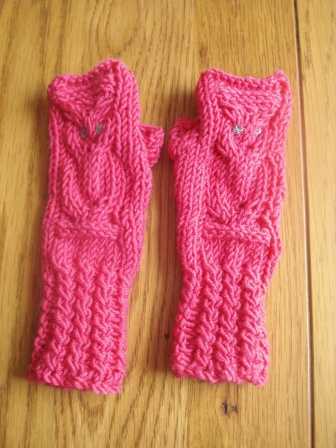
A hat, a cowl and some owl wrist warmers - January's been busy!
Here's my latest train knitting project:
It is from Wendy Knits Lace and will be my first ever hat; the only problem with this book is that it is American so a lot of the yarns aren't available over here - I'm using Rowan Lima Alpaca Mix Yarn in Andes. Most excitingly, it is destined for..... me! Counting up for the purposes of this blog post, I've discovered that it has been more than two years since I made something just for me. This is in part due to the fact that I got very excited knitting things for Izzy, even before she arrived (baby knits are just soooooo quick!) but also because for the last two years I've been trying to reduce the number of presents I buy, in favour of something handmade.
Take January as an example - both my mother and my daughter have birthdays two days apart. This meant that I got to create this:
and these:
both of which have stretched my knitting skills and kept me occupied on my commute to and from work. I've done my first project on double-pointed kneedles, my first and then second project knitted in the round and my first lace project all within about 3 weeks!
But this one's for me and I'm enjoying it without guilt, knowing that next month's going to be all about new-baby gifts (there's four on the way among friends and family).
| This is the project at week one of being knitted up on the train - I've just finished the hat 'cuff' and will be starting the lace pattern for the crown next week. |
It is from Wendy Knits Lace and will be my first ever hat; the only problem with this book is that it is American so a lot of the yarns aren't available over here - I'm using Rowan Lima Alpaca Mix Yarn in Andes. Most excitingly, it is destined for..... me! Counting up for the purposes of this blog post, I've discovered that it has been more than two years since I made something just for me. This is in part due to the fact that I got very excited knitting things for Izzy, even before she arrived (baby knits are just soooooo quick!) but also because for the last two years I've been trying to reduce the number of presents I buy, in favour of something handmade.
Take January as an example - both my mother and my daughter have birthdays two days apart. This meant that I got to create this:
| 'Elizabeth's Cowl', also from Wendy Knits Lace in the same yarn as my hat. I even did the whole 'blocking' thing to bring out the lace pattern - this year has been chock-a-block full of new skills! |
| I adapted these cute owl wrist warmers from a pattern in Mollie Makes magazine. Intended for an adult, I swapped out the chunky yarn for a dk merino one and Voila! a pair of toddler wrist warmers - more practical than traditional mittens (which she won't wear) and so far, she loves them! |
But this one's for me and I'm enjoying it without guilt, knowing that next month's going to be all about new-baby gifts (there's four on the way among friends and family).
Tuesday, 8 January 2013
Shouldn't we get her some more?
![]() |
| 'Essentials' from ELC |
But then we come to occasions. You know - the sort where you get presents. And I like presents - and the more there are the better. There's nothing quite like the pile under the tree at Christmas - I find squishing and prodding irresistible and regularly 'restack' everyones presents for 'aesthetic' and 'organisational' reasons. I also enjoy a good birthday haul - and it doesn't even have to mine. I love giving presents as much as receiving them - particularly if I've spent a lot of time planning and sourcing something, or coming up with a great, or unusual gift or 'experience', or I've made something myself. For adults, this at least translates into one or two thoughtful presents. But for some reason, when it comes to Izzy, I feel an overwhelming urge to splurge on as many things as possible and I really don't know why! I wasn't deprived of 'things' as a child - in fact with no siblings I probably had a lot more bought for me than my contemporaries in larger families. Having said that, I don't think (with two primary school teachers for parents) that I was unduly spoiled when it came to volume of gifts.
But when it comes to Izzy's second birthday next week, it's me who's having to be reined in from buying 'just one more thing'. I think this is probably why it was so funny to read the piece in The Guardian today on 'going cold turkey on kiddie consumerism', as I'm obviously not the only parent out there who, for whatever reason, can't stop buying things for their little ones. At least my mania only hits me for these two months over Christmas and her birthday in January - the rest of the year I tend to get by with 're-purposing' household objects into new toys.
Oh well - I'm off to redirect this desire for 'one more' birthday gift into the creation of a pair of fingerless mittens, made from wool from my stash rather than anything bought new, and for the prosaic reason that my darling daughter absolutely refuses to wear her normal gloves at the moment.
Saturday, 5 January 2013
January in the garden (part 1): Tidy up time!
'Tidy up time!' - My daughter is fond of saying this once she's spread as many of her toys across the living room as is physically possible, then stands by to supervise as Mummy picks them all up and puts them away.
Sadly for me, there is no one to tidy up the mess I made in the garden and greenhouse last growing season (well, except WH, and he'd only put things away where I couldn't find them!), so this January is going to be all about the cleaning and the clearing, ready for the spring sowing marathon.
Hmm, now what exactly needs doing again?
| 40 clean pots and 7 soapy propagator units |
Hmm, now what exactly needs doing again?
- Wash all the plastic sowing and potting-on paraphernalia, including pots, seed trays and modules, and electric propagator units
- Tidy out the greenhouse, including throwing away old plant labels and bits of rubbish, and group items together (watering-related items, nuts and screws, pegs, plant food, tools, etc)
- Scrub down the potting table and the greenhouse staging and shelving
- Clean the greenhouse, inside and out
- Replant some of the overwintering garlic which has 'popped' out of the bed
- Weed and cover last year's beans and peas bed with frame and micromesh
- Dig through last year's roots bed - there may well be some beetroot and parsnips to harvest
- Dig through the brassica bed - this has been terribly unsuccessful this year as we had a bit of an infestation of caterpillars, which didn't leave us much apart from stalks!
- Thin out the teeny tiny leeks (I planted them too late in the season) and hope they grow a bit for spring cooking.
- Various other tidying jobs, including raking up leaves, replanting bulbs, etc, and that's without going anywhere near 'the heap' between the greenhouse and the shed where we 'store' (dump) used compost, compost bags, bits of trellis, broken tools, larger containers, etc, etc..
There is really so much to do, that I've had to break it up into lots of little parcels of tasks to stand any chance of not just putting it all off (probably forever - some of these tasks I've never actually gotten around to in the 3.5 years we've lived here!) So this morning I spent a good two hours cleaning the units for the electric propagator and about 1/3rd of the plastic pots, with the rationale that these will be used first for February sowing, so even if I do prevaricate on further cleaning, I'll at least be able to start the 2013 growing season! I also achieved items 2 and 3 on the list, and washed half of the inside of the greenhouse - once I got started, I was actually very productive!
As a reward for today's hard work I'm planning to start looking through my piles of seed and plant catalogues tomorrow to prepare my order for our new season.
(to the tune of Bing Crosby's White Christmas)
I'm... dreaming of a .... full harvest,
not like the one the year before.
Where no snail trails glisten,
or garden birds listen,
for the sound of unprotected berries ripen-ing.
Wednesday, 2 January 2013
January in the kitchen (part 1): sugar and spice and a butternut
For many home cooks, January represents a month of paring back after the excesses of December; of a return to comforting foods with simple flavours. The danger in this, for me at least, is that these leanings can result in a month of puddings and pies, of mountains of mash and seriously little innovation.
This year I've decided to sweep away the New Year gloom and warm up with spicy-ness in place of stodge. Lingering in the veg cupboard this week is a pre-Christmas, medium-sized butternut squash (keeping well), a small red onion, some carrots (going a bit slimy) and three or four small leeks (which have seen distinctly better days). As anyone with a veg box, an allotment, or some other means of acquiring large quantities of vegetables will know, you will always have enough of everything to make excessive quantities to eat/freeze or need to make at least two recipes simultaneously to use everything up. As the mother of an almost-two-year-old I can multitask with the best of them, so here's my butternut combo for the first week in January. (Allow me a moment to bask in the glow that comes from having created not one, but two original recipes in one afternoon!)
Butternut, thyme and goats cheese pasties/Spicy orange soup
You will need:
x1 medium butternut squash, peeled and diced
x4-6 cloves of garlic (to taste)
x1 small red onion, chopped finely
x3 small leeks, cut into £1-coin slices
x3 or 4 medium carrots, peeled and diced
x1 litre of water
x200ml veg stock
A mild goat's cheese (one of those small round ones)
puff pastry (about 450g, ready to roll is fine!)
x1 medium orange, zest and juice
x1 medium egg, beaten
chilli flakes (to taste, or real chillies)
rosemary (to taste)
thyme (to taste)
olive oil
(optional) creme fraiche, cream, Thai hot chilli sauce to serve (with soup - it would just be plain weird with a pasty)
1. Chop the onion and add it to a pan with some olive oil to sweat for 5 minutes. Whilst the onion is sweating, chop a couple of cloves of garlic (our garden bulbs were a bit on the small side this year, so I used 3 cloves), and dice half the butternut squash. Add these to the pan with the onion, plus 1 tsp (or however much you fancy) chilli flakes and 2 tsp (again, or as much as you like) of dried thyme, and cook over a medium heat for five minutes to add some colour whilst you make up your 200ml vegetable stock. Add this to the pan, cover with a lid, bring to the boil then simmer gently for 10 minutes.
2. Wash and chop your leeks and add them to a large pan to sweat for 5 minutes in some olive oil. Chop the remaining half of your butternut squash, and add it to the pan along with 1 tsp chilli flakes, 1 tsp dried rosemary and 1 tsp dried thyme (again, amend these quantities as you like). Zest and juice your orange and then add the juice to the pan and heat gently for 1 minute. Give it all a stir and then add 1 litre of boiling water, bring the pan to the boil then cover and simmer for about an hour to an hour and a half.
3. The stock in your first pan should now have been reduced to about one third the volume and your butternut should be cooked through.Take the pan off the heat and roughly mash into a lumpy paste. Allow to cool.
4. Take your pastry out of the fridge and on a lightly floured board, chop off about an eighth of your pastry block and roll it into approx a 15cmx15cm sheet. Add a dollop of the butternut mixture to each square, crumble some goat's cheese on top, then brush around the edges of the square with your beaten egg. Fold into a triangle, crimp your pasty edges, then transfer to a greased baking sheet. Repeat until you filling is gone (mine made 6 pasties). Stick your knife in for a steam hole and brush the tops with the rest of your beaten egg, then transfer to a fan oven at 180 C (210 C) for about 25 minutes until the pastry has turned golden brown. Allow to cool slightly before eating.
5. Some time after you've finished your pasty/ies your soup will be finished. Take it off the heat and either leave to cool and then refrigerate or freeze as is, or stick half/all of it in a blender and puree to a thick soup. You can add a dollop of creme fraiche or cream before serving, and I'll be adding some Thai hot chilli sauce to mine for an extra kick (I had to make the base soup relatively mild so that Izzy would eat it too!)
If you've stuck with me thus far, the keen-eyed amongst you might have wondered about where the orange zest went. I used this to whip up a batch of Abel & Cole's Citrus and Spice Shortbread for their January baking recipe photo comp.
The shortbread is better than the picture - doubt I'll be winning any prizes this month!
This year I've decided to sweep away the New Year gloom and warm up with spicy-ness in place of stodge. Lingering in the veg cupboard this week is a pre-Christmas, medium-sized butternut squash (keeping well), a small red onion, some carrots (going a bit slimy) and three or four small leeks (which have seen distinctly better days). As anyone with a veg box, an allotment, or some other means of acquiring large quantities of vegetables will know, you will always have enough of everything to make excessive quantities to eat/freeze or need to make at least two recipes simultaneously to use everything up. As the mother of an almost-two-year-old I can multitask with the best of them, so here's my butternut combo for the first week in January. (Allow me a moment to bask in the glow that comes from having created not one, but two original recipes in one afternoon!)
Butternut, thyme and goats cheese pasties/Spicy orange soup
You will need:
x1 medium butternut squash, peeled and diced
x4-6 cloves of garlic (to taste)
x1 small red onion, chopped finely
x3 small leeks, cut into £1-coin slices
x3 or 4 medium carrots, peeled and diced
x1 litre of water
x200ml veg stock
A mild goat's cheese (one of those small round ones)
puff pastry (about 450g, ready to roll is fine!)
x1 medium orange, zest and juice
x1 medium egg, beaten
chilli flakes (to taste, or real chillies)
rosemary (to taste)
thyme (to taste)
olive oil
(optional) creme fraiche, cream, Thai hot chilli sauce to serve (with soup - it would just be plain weird with a pasty)
1. Chop the onion and add it to a pan with some olive oil to sweat for 5 minutes. Whilst the onion is sweating, chop a couple of cloves of garlic (our garden bulbs were a bit on the small side this year, so I used 3 cloves), and dice half the butternut squash. Add these to the pan with the onion, plus 1 tsp (or however much you fancy) chilli flakes and 2 tsp (again, or as much as you like) of dried thyme, and cook over a medium heat for five minutes to add some colour whilst you make up your 200ml vegetable stock. Add this to the pan, cover with a lid, bring to the boil then simmer gently for 10 minutes.
2. Wash and chop your leeks and add them to a large pan to sweat for 5 minutes in some olive oil. Chop the remaining half of your butternut squash, and add it to the pan along with 1 tsp chilli flakes, 1 tsp dried rosemary and 1 tsp dried thyme (again, amend these quantities as you like). Zest and juice your orange and then add the juice to the pan and heat gently for 1 minute. Give it all a stir and then add 1 litre of boiling water, bring the pan to the boil then cover and simmer for about an hour to an hour and a half.
![]() |
| Butternut and carrots, diced, plus the obligatory half-mug of cold tea |
4. Take your pastry out of the fridge and on a lightly floured board, chop off about an eighth of your pastry block and roll it into approx a 15cmx15cm sheet. Add a dollop of the butternut mixture to each square, crumble some goat's cheese on top, then brush around the edges of the square with your beaten egg. Fold into a triangle, crimp your pasty edges, then transfer to a greased baking sheet. Repeat until you filling is gone (mine made 6 pasties). Stick your knife in for a steam hole and brush the tops with the rest of your beaten egg, then transfer to a fan oven at 180 C (210 C) for about 25 minutes until the pastry has turned golden brown. Allow to cool slightly before eating.
5. Some time after you've finished your pasty/ies your soup will be finished. Take it off the heat and either leave to cool and then refrigerate or freeze as is, or stick half/all of it in a blender and puree to a thick soup. You can add a dollop of creme fraiche or cream before serving, and I'll be adding some Thai hot chilli sauce to mine for an extra kick (I had to make the base soup relatively mild so that Izzy would eat it too!)
If you've stuck with me thus far, the keen-eyed amongst you might have wondered about where the orange zest went. I used this to whip up a batch of Abel & Cole's Citrus and Spice Shortbread for their January baking recipe photo comp.
![]() |
| So nice, a bit has already disappeared... |
Monday, 31 December 2012
Clickety clack, clickety clack...
What's that? Clickety clack, clickety clack - its the sound of a commuter knitting along the track. Well - not actually 'on' the track - that would be a hazard! Just as a train passenger (but that doesn't scan as well).
In my November blog about how I love reading, I confessed to having purchased in excess of 150 ebooks in a two year period. This was in no small part due to my daily commute, when there really isn't much else to do for 25 minutes either way, but
So that leaves only one other pastime for commuting that can help keep my bank balance looking a little healthier - knitting! I really only thought of this because I'd wanted to make Izzy a scarf for Christmas, and as the second week of November loomed and all free time at home was spent in the kitchen on edible goodies, the only time left available to me for making it was during my journey to and from work.
The pattern is from the MillaMia Bright Young Things book and the yarn is Debbie Bliss eco baby (100% organic cotton) in mint and white. This was my first real attempt at intarsia, or stranded, knitting - and required me to learn the continental knitting technique (where the yarn is held in the left hand) for my second colour. I chose a cotton yarn because Izzy has sensitive skin and I didn't want it to be itchy, but this did mean that the scarf was a bit prone to rolling up, even after pressing, so I backed it with some organic fleece I had left over from another project (and which, by the way, turned out to be the first time I used my new sewing machine!). One toddler scarf, completed in 6 weeks of commuting (6 weeks x 4 days = 48 journeys of 20 mins or 16 hours + time to apply the backing, which obviously wasn't done on the train.)
In my November blog about how I love reading, I confessed to having purchased in excess of 150 ebooks in a two year period. This was in no small part due to my daily commute, when there really isn't much else to do for 25 minutes either way, but
- sleep (but I might miss my stop and end up in London/Bournemouth or Manchester depending on the direction of travel);
- listen to other people's conversations (always entertaining - especially the two young ladies who I often end up sitting near to on the 8.10am, one of whom has possibly the worst housemate in the world)
- read - the Metro used to keep me entertained when I first started commuting, but my kindle quickly supplanted my news reading, as I'd always rather be kept amused by something made up, rather than being depressed by how awful the world/state of journalism has become.
So that leaves only one other pastime for commuting that can help keep my bank balance looking a little healthier - knitting! I really only thought of this because I'd wanted to make Izzy a scarf for Christmas, and as the second week of November loomed and all free time at home was spent in the kitchen on edible goodies, the only time left available to me for making it was during my journey to and from work.
The pattern is from the MillaMia Bright Young Things book and the yarn is Debbie Bliss eco baby (100% organic cotton) in mint and white. This was my first real attempt at intarsia, or stranded, knitting - and required me to learn the continental knitting technique (where the yarn is held in the left hand) for my second colour. I chose a cotton yarn because Izzy has sensitive skin and I didn't want it to be itchy, but this did mean that the scarf was a bit prone to rolling up, even after pressing, so I backed it with some organic fleece I had left over from another project (and which, by the way, turned out to be the first time I used my new sewing machine!). One toddler scarf, completed in 6 weeks of commuting (6 weeks x 4 days = 48 journeys of 20 mins or 16 hours + time to apply the backing, which obviously wasn't done on the train.)
Sunday, 16 December 2012
Homemade gifts (2) - thank goodness it isn't a trilogy!
The end is in sight - a manic fortnight of candying, preserving, baking and wrapping has almost reached its conclusion (and in time for the second class post, too!) I thought it would be illuminating to write a post about handmade gifts whilst this period of frenzied activity is fresh in my mind, as, too often, in the hazy post-Christmas glow I find myself downplaying the sheer amount of time and effort that goes into creating what is, in the end, only a handful of edible festive boxes. In the last two weeks I've alternately felt:
- smug (that I'm giving friends and family something completely unique);
- worried (that everything wasn't going to come together in time;
- resentful (lets not go there...);
- angry (with myself, for choosing NOW as a time to experiment with a new, completely untried recipe that resulted in a completely wasted afternoon with masses of sticky washing up and no 'gift element');
- panicky (that no one will like what I've sent them/that some of the foods won't have kept well/that there isn't enough in each box);
- satisfaction (as each box is packed up, with ribbon and trimmings);
- boredom (trying to use the Post Office in central Reading on the second Saturday before Christmas results in a lot of standing around in a queue);
- utter relief that it's all over for another year
Maybe next year I'll just do a bit of chifting (charity shop gifting to the uninitiated)....!http://www.govtoday.co.uk/local-government/19-economic-growth/14189-christmas-trading-could-be-a-slow-burner-for-charity-shops
Tuesday, 4 December 2012
Green Christmas gift guide: Homemade gifts (1)

An interesting piece in The Guardian today on 'Are homemade Christmas presents always better?' I'd have to question their premise though, as the reasons most of us give homemade gifts isn't to compete with a shop-bought alternative (on quality or price), but because we enjoy making and like to demonstrate our affection for our loved ones by spending not just money, but that other most precious commodity, time.
For the last two years I've made homemade gifts to give to friends and family at Christmas. Both years I've produced an edible hamper with a range of goodies from our garden raspberry gin, to mini Christmas puddings, to popping corn complete with homemade seasoning. Almost every component could have been bought from a shop, and unlike some of the examples cited in the Guardian article, I'm pretty sure that mine cost more to make! But if I'd bought everything, the hamper just wouldn't have been the same. And I certainly wouldn't have been able to bask in the glow of a job well done, or feel a sense of pride every time one of the recipients told me how much they'd enjoyed something.
And that's why I'll be making presents again this Christmas.
Sunday, 2 December 2012
Green Christmas gift guide: Gifts of membership
Added to my Green Christmas gift ideas board on Pinterest today - some ideas for those of you looking for something a little different for your eco-conscious friends and relations: gifts of membership.
Saturday, 1 December 2012
John Lewis: I love you and I hate you (with an aside about M&S)
Ah - the first Saturday in December in Reading town centre. Truly hideous! Still, I was on a mission to by my new sewing machine, and after weeks of research and prevaricating, today was the day I'd go to John Lewis and buy it. Or not. And I'm afraid this has led me to list the reasons why, John Lewis (Reading), that I love you and I hate you:
No thanks - I think I'll just go and buy a machine from Argos, where I can order it online and the item will be waiting for me to collect it, at an easily accessible store, within a few hours. Of course, having just looked at the John Lewis website, this option also appears to be available to me, if I buy a sewing machine from them too (I can specify that I want to collect from the town centre store, rather than Mill Lane) - would have been helpful to be told that by the 'assistant'.
Oh, and Marks & Spencer - what's the point of having a Plan A to support, amongst other things, the environment and then having your heating turned up so high at the beginning of December that your staff are all wearing t-shirts?!!
- I love you because: of your business model. It's a good one, and more organisations should consider following it and having actual principles to act upon, rather than corporate social responsibility waffle.
- I hate you because: your model doesn't go quite far enough in today's society. Where is your commitment to fairtrade, to British-made, to organic in the products and concessions you stock/support?
- I love you because: you have an excellent, child-friendly cafe.
- I hate you because: you only have a single toilet in the parent room, and toddlers don't like waiting.
- I love you because: you have an actual haberdashery, one of only two (that I'm aware of) in Reading town centre and by far the better stocked.
- I hate you because: you've now moved it to a difficult-to-access mezzanine area, meaning I can't just pop in to browse if I've got the pushchair with me.
- I love you because: you're never knowingly undersold - and that's a good promise.
- I hate you because: of the experience I had today. Sewing machines aren't really very big, or heavy, in the grand scheme of things, so why can I not just go into your store and pick one up to take away with me (after paying for it, obviously)? The only options I was offered by the surly sales assistant (after the clueless till boy had gone off to get some assistance) was to pick it up 'from Mill Lane' or have it 'delivered'.
'Where is Mill Lane?', I asked.
(Vague pointing) 'Oh, over that way, by the IDR - easy to get to by car.'
'I don't have a car', quoth I.
'Oh. Well you can have it delivered for free.'
'When would it be delivered?'
'Oh, within the next 10 days - we can't guarantee when.'
'But I'm at work on week days so would need to know when it was arriving.'
'Well, you could pay £50 for Parcelforce Delivery.'
Oh, and Marks & Spencer - what's the point of having a Plan A to support, amongst other things, the environment and then having your heating turned up so high at the beginning of December that your staff are all wearing t-shirts?!!
Friday, 30 November 2012
A new craft habit: crochet
Whilst I've always dabbled with a range of crafts, my staple needle-based activity has always been knitting. No longer - not only am I about to be the proud owner of a Singer Tradition sewing machine, I've also - finally - mastered basic crochet (thanks to a quick tutorial from a crochet-master friend, and an evening class at the wonderful Make & Do).
My first project - a blanket for Izzy for when she's in the buggy - was officially finished this evening! Although now the problem is, of course, that I've even more potential future projects to consider...
The blanket dimensions are 600mmx700mm. The pattern is taken from First Crochet by Lesley Stanfield but I changed the colourway, the dimensions (from a full-size throw) and added extra edging to make a thicker border. The main yarn used is Scappa Aran, an exclusively hand-dyed Scottish wool, in scarlett, pillar box and cream. I picked up 2x100g balls on a break in Edinburgh a few years ago and they've been waiting for the right project ever since. The grey highlighter yarn came from my stash, left-over from the very cool Lotta Striped Bolero I knitted for Izzy from the Millamia Bright Young Things collection, using their own-brand extra fine merino yarn.
My first project - a blanket for Izzy for when she's in the buggy - was officially finished this evening! Although now the problem is, of course, that I've even more potential future projects to consider...
The blanket dimensions are 600mmx700mm. The pattern is taken from First Crochet by Lesley Stanfield but I changed the colourway, the dimensions (from a full-size throw) and added extra edging to make a thicker border. The main yarn used is Scappa Aran, an exclusively hand-dyed Scottish wool, in scarlett, pillar box and cream. I picked up 2x100g balls on a break in Edinburgh a few years ago and they've been waiting for the right project ever since. The grey highlighter yarn came from my stash, left-over from the very cool Lotta Striped Bolero I knitted for Izzy from the Millamia Bright Young Things collection, using their own-brand extra fine merino yarn.
Thursday, 29 November 2012
Green Christmas - Pinterest ideas
Just a quick one tonight as I've been ill today. My inbox is being inundated at the moment with Christmas-related emails from the many eco companies I've purchased things from over the last few years. Some of the ideas for gifts and decorating are pretty cool - so I've started a pinterest board to share them all with you. First up - a range of items from Nigel's Eco Store - an excellent place to find quirky and unusual gifts for the greenies (light and dark) in your life. They've also got some quite different presents for children - we bought Izzy one of their cardboard toddler chairs last year, and she loves it (although we've yet to get round to decorating it yet - maybe next year!)

Wednesday, 28 November 2012
'Nanny watchdog'?! Oh good grief!
Not sure their Picture Editor is on the same page as the Sub Editor, though. The 'Families should even sell their car to end the 'bad habit' of using it for trips of less than a mile and walk instead' header is illustrated by a picture of a smiling, happy-looking family, all of whom look as if they're not only enjoying their 'enforced' walk, but that they may even be the healthier for it.
And of course, in true Mail fashion, they appear to have picked on the one contentious matter in the whole report, which is basically about how to get more of us walking and cycling, for our health, for the environment and for the economy. Go figure.
Tuesday, 27 November 2012
What happens when you build on a floodplain?
You get flooded.
![]() |
| This is a picture of part of the railway line near Oxford, this morning, on my commute. |
What we all tend to forget as the water rises, posing a risk to our homes, our possessions and our already fraught commutes, is that flooding is a natural occurrence. At the most basic level, floodplains provide somewhere for excess water to go after a period of heavy rains. River waters leave behind silt-rich soils which are excellent for agriculture, and which is why man began to build on the floodplain, despite the risks.
The problem is that we've kept on building. According to a report by the Chartered Insurance Institute 'While new building in flood hazard areas has virtually ceased in Scotland, Wales and Northern Ireland, it has continued in England.' This means that English planning authorities are being especially short-sighted about the impacts of building on floodplains. Even flood defenses - built to protect a town - can have an impact further up or down the river, causing flooding in areas previously unaffected, or making existing floods worse. It will, however, be the public that suffers from 1 July next year when the Government's agreement with the insurance industry for providing cover to properties at risk of flooding expires and is unlikely to be renewed. According to the Environment Agency 'Over 5 million people in England and Wales live and work in properties that are at risk of flooding from rivers or the sea' - that's a lot of people who are suddenly going to find it difficult to insure their homes against flood damage, at least without paying a premium that many won't be able to afford.
And that's just the cost to humans. The problem with modern building materials - like tarmac and concrete - is that they don't allow for the slow draining away of flood waters into the water table, instead dumping the excess water straight into our overwhelmed sewer network, which then overflows into rivers and other water courses, creating new environmental problems such as the poisoning of fish and other creatures, or encouraging the build up of algae.
We desperately need to find a way to build and live more in harmony with our environments, rather than trying to impose our presence at the cost of ecosystems and habitats, and ultimately, our homes and our own safety. Maybe we could start by banning any further development on floodplains?
Monday, 26 November 2012
All bark, no bite for the supermarket watchdog
About 10 years ago I read a book which had a big impact on how I thought about food, and particularly food shopping. Bad Food Britain: How a Nation Ruined its Appetite by Joanna Blythman really brought home to me the shocking state of our British food culture, and how we should all, ultimately, be responsible for thinking about what we eat, as well as how our food gets to us, and make choices which support sustainable and ethical practices both here and in the increasing number of developing countries which support our desire for, among other things, out-of-season salads.
Fueled by information from Blythman's Shopped, Felicity Lawrence's Not on the Label, and Paul Robert's The End of Food WH and I gradually moved to a situation where, whilst without giving up a supermarket shop entirely, we were purchasing (and continue to purchase) the majority of our food from a combination of local suppliers and an organic box scheme. As I've commented many times before, we've long been in the habit of making about 90% of our meals from scratch, we bake our own bread and we make an effort to grow and preserve our own.
However, for those of us juggling commutes, small children, demanding jobs, and time spent with friends and families, supermarkets do offer the convenience of picking up a range of essentials in one fell swoop. The Cooperative, Marks & Spencer and Waitrose consistently come out top in polls looking at ethical supermarkets, but sadly in a 2011 poll by The Grocer, a supermarket's ethics are the top driver for where we shop for only 6% of us, meaning that any sweeping change to how supermarkets operate still needs to be driven by regulation and government oversight.
Making it doubly disappointing that the government's promised Supermarkets Ombudsman has already been downgraded to an adjudicator - thus focusing on a reactive approach relying on complaints being brought, rather than a proactive curb on abuses relating to suppliers, food adulteration, price-fixing, etc, etc. Not to mention how such a watchdog might have been able to address the negative impact supermarkets have on jobs, average wages, animal welfare, and the environment (at the local, national and international level).
Another let down from this coalition government.
Fueled by information from Blythman's Shopped, Felicity Lawrence's Not on the Label, and Paul Robert's The End of Food WH and I gradually moved to a situation where, whilst without giving up a supermarket shop entirely, we were purchasing (and continue to purchase) the majority of our food from a combination of local suppliers and an organic box scheme. As I've commented many times before, we've long been in the habit of making about 90% of our meals from scratch, we bake our own bread and we make an effort to grow and preserve our own.
However, for those of us juggling commutes, small children, demanding jobs, and time spent with friends and families, supermarkets do offer the convenience of picking up a range of essentials in one fell swoop. The Cooperative, Marks & Spencer and Waitrose consistently come out top in polls looking at ethical supermarkets, but sadly in a 2011 poll by The Grocer, a supermarket's ethics are the top driver for where we shop for only 6% of us, meaning that any sweeping change to how supermarkets operate still needs to be driven by regulation and government oversight.
Making it doubly disappointing that the government's promised Supermarkets Ombudsman has already been downgraded to an adjudicator - thus focusing on a reactive approach relying on complaints being brought, rather than a proactive curb on abuses relating to suppliers, food adulteration, price-fixing, etc, etc. Not to mention how such a watchdog might have been able to address the negative impact supermarkets have on jobs, average wages, animal welfare, and the environment (at the local, national and international level).
Another let down from this coalition government.
Sunday, 25 November 2012
Eat me/Drink me
If there's only one area where I'm actually on schedule this year, its in the preparation for lovely Christmas comestibles. Today is Stir-up Sunday but in a break from the (recent) tradition of a No 27 Christmas Pudding, 2012 will see my first attempt at a Christmas cake and tonight it has had its second 'feed'.
Because I can never stick to an actual recipe, this cake has the potential to be wonderful or dreadful. I substituted a fair amount of the dried fruits, increased the amount of nuts, and rather than sticking to the more traditional brandy or whisky for the spirituous ingredient I've mixed it up with some of our homemade raspberry gin from last year.
Watch this space towards the middle of December as there's bound to be a post about the trials of attempting to decorate the cake (hubby has already demanded a complicated Christmas scene featuring a range of characters and cake furniture - all to be handmade, whilst I was thinking more along the lines of a nice snow scene, with maybe a touch of 'frost').
Because I can never stick to an actual recipe, this cake has the potential to be wonderful or dreadful. I substituted a fair amount of the dried fruits, increased the amount of nuts, and rather than sticking to the more traditional brandy or whisky for the spirituous ingredient I've mixed it up with some of our homemade raspberry gin from last year.
Watch this space towards the middle of December as there's bound to be a post about the trials of attempting to decorate the cake (hubby has already demanded a complicated Christmas scene featuring a range of characters and cake furniture - all to be handmade, whilst I was thinking more along the lines of a nice snow scene, with maybe a touch of 'frost').
Saturday, 24 November 2012
What did you buy today?
It seems like a great idea - everyone can stop shopping for just a day, right? However, if the idea is to start people off with baby steps towards a more environmentally- and socially-conscious purchasing life, then why stage the event:
a) on the last weekend in November, just as the Christmas shopping mania is kicking off?
b) on a Saturday, when the majority of people 'need' to do some kind of shopping - for food, for example?
c) with almost no real promotion?
And I think it is the latter that is the most confusing. It feels like the green movement has always been a little slow on the uptake - they started out by vilifying the computer age as a wasteful succession of gadgets, rather than embracing the communications opportunities these technologies afford us. Similarly, advertising still seems to be seen as the poison of the Big Bad Corporates, and as such can't possibly be applied to anti-consumerist campaigns and activities.
But perhaps if more people knew about Buy Nothing Day, then more people would have taken part. The green movement has had some great successes in recent years as more charities and organisations have woken up to the idea that the majority of people, when presented with an option, won't make the 'greener' choice unless it is explained to them why they should. I'm all for less consumption - the 20% of us in the developed world are consuming more than 80% of the planet's resources after all. Surely 'Buy Nothing Day' should be something that is in the public consciousness and not a hidden sidebar in a couple of niche publications aimed at those who're already sold on the green lifestyle.
A social media campaign seems like a no-brainer, but neither I, nor my far more social-media-dependent husband were aware of anything. As it happens, I didn't buy anything today, but that's just a reflection of the fact that Saturday mornings the other half takes our daughter into town and I get a lie-in, coupled with the fact that we had visitors this afternoon and I'm still in the planning phases for my Christmas purchases. Still, maybe next year I'll consciously choose to support 'Buy Nothing Day'. I might even help them spread the word a bit more...
Friday, 23 November 2012
National Tree Week
Every week seems to be 'National Week', but 24 November to 2 December in the UK is the week of the tree.
National Tree Week is run, predominantly, by The Tree Council who organise events around the country in support of their campaign to get us all thinking about, and planting, trees. The idea has been around for almost 40 years, since the government introduced the idea of the National Tree Planting Year in 1973 to encourage the public to help replace the millions of trees killed by Dutch Elm Disease.
With pests and diseases threatening some of our most iconically British trees in recent years, such as oak, horsechestnut and ash, our woodlands and forests need our attention and protection more than ever. If you don't have the outdoor space to plant a tree, you could consider getting involved with the Woodland Trust's initiative to encourage community planting: find a piece of land in your local area that would benefit from trees, ask the permission of the landowner and get other local people involved, and then apply to the Trust for a free tree pack. The packs are worth up to £420 and are 'themed' around the type of situation, resource or habit you are trying to create from bee-friendly groupings to the provision of community firewood. The offer is also open to schools.
Another excellent option as the festive season approaches is to gift the planting of a tree in existing forest or woodland to a friend or relative. There are a number of schemes around the country to help you achieve this; I've been both a recipient and a giver via the National Forest's plant a tree scheme. I'm still yet to take them up on actually seeing my tree planted (and may have missed the window for this, sadly), but we'd love to take Izzy in the next year, to plant the tree we 'gifted' to mark her birth. I can see this being something of an anniversary activity, where each year we visit the National Forest to see how 'her' tree is getting on - certainly better from an environmental standpoint than some joyless party in a stuffy, overheated eatery or over-merchandised kiddy theme park.
I was sceptical to start with, but maybe National Tree Week has its place after all - even if it is just to act as a reminder to me to dig out the information about our respective tree-planting gifts. It certainly makes more sense to me than National Engineers Week (17-23 Feb) or National Careers Week (4-8 Mar). Farmhouse Breakfast Week (20-26 Jan) on the other hand ...
National Tree Week is run, predominantly, by The Tree Council who organise events around the country in support of their campaign to get us all thinking about, and planting, trees. The idea has been around for almost 40 years, since the government introduced the idea of the National Tree Planting Year in 1973 to encourage the public to help replace the millions of trees killed by Dutch Elm Disease.
With pests and diseases threatening some of our most iconically British trees in recent years, such as oak, horsechestnut and ash, our woodlands and forests need our attention and protection more than ever. If you don't have the outdoor space to plant a tree, you could consider getting involved with the Woodland Trust's initiative to encourage community planting: find a piece of land in your local area that would benefit from trees, ask the permission of the landowner and get other local people involved, and then apply to the Trust for a free tree pack. The packs are worth up to £420 and are 'themed' around the type of situation, resource or habit you are trying to create from bee-friendly groupings to the provision of community firewood. The offer is also open to schools.
Another excellent option as the festive season approaches is to gift the planting of a tree in existing forest or woodland to a friend or relative. There are a number of schemes around the country to help you achieve this; I've been both a recipient and a giver via the National Forest's plant a tree scheme. I'm still yet to take them up on actually seeing my tree planted (and may have missed the window for this, sadly), but we'd love to take Izzy in the next year, to plant the tree we 'gifted' to mark her birth. I can see this being something of an anniversary activity, where each year we visit the National Forest to see how 'her' tree is getting on - certainly better from an environmental standpoint than some joyless party in a stuffy, overheated eatery or over-merchandised kiddy theme park.
I was sceptical to start with, but maybe National Tree Week has its place after all - even if it is just to act as a reminder to me to dig out the information about our respective tree-planting gifts. It certainly makes more sense to me than National Engineers Week (17-23 Feb) or National Careers Week (4-8 Mar). Farmhouse Breakfast Week (20-26 Jan) on the other hand ...
Subscribe to:
Posts (Atom)